


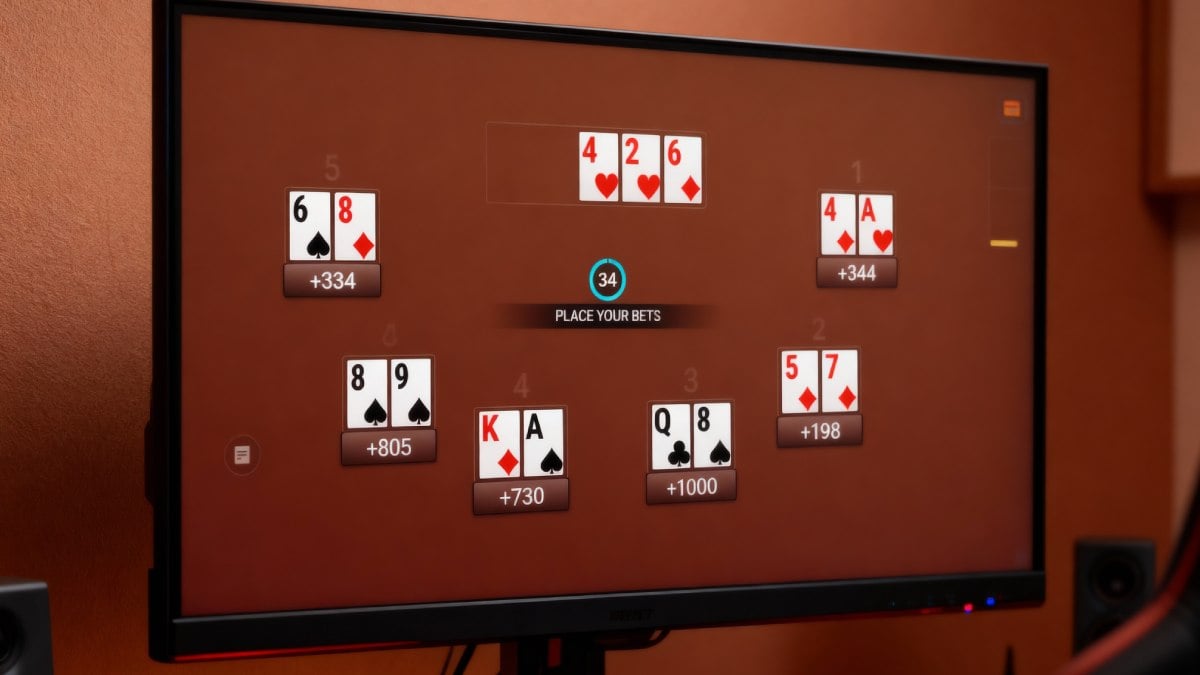

Walk into any poker room and you’ll hear a language of its own. Players discuss “3-betting the button,” “having blockers to the nuts,” or being “coolered on the bubble.” To outsiders, it sounds like code. To those who understand, it’s the vocabulary that separates recreational play from strategic competition.
Poker terminology isn’t decoration. It’s precision. Every term carries a specific meaning that clarifies strategy, analyzes hands, and communicates complex situations efficiently.
This comprehensive glossary covers fundamental action terms, positional concepts, mathematical calculations, strategic ideas, common slang expressions, hand nicknames, structural elements, and tournament-specific vocabulary that every poker player encounters regularly.
Poker Moves: Core Action Terms
Poker revolves around betting actions that determine pot size and hand outcomes. Master these six fundamental moves first.
Bet: The first wager placed into the pot on any betting round. When no previous bet exists, a player may initiate action by betting.
Check: Declining to bet while retaining the right to act later in the betting round. Players can only check when no bet has been placed. Checking passes the action to the next player without adding chips to the pot.
Call: Matching the current bet amount to remain in the hand. A player facing a $50 bet must call $50 to continue.
Raise: Increasing the current bet amount, forcing subsequent players to match the new, larger amount or fold. A player facing a $50 bet might raise to $150, requiring others to call $150.
Fold: Surrendering the hand and forfeiting any claim to the pot. Folded hands cannot win regardless of subsequent card outcomes.
3-Bet: A re-raise, specifically the third bet in a sequence. If one player raises and another re-raises, that second raise constitutes a 3-bet. Pre-flop, if the big blind counts as the first bet, a raise is the second bet, and a re-raise becomes the 3-bet.
4-Bet: A re-raise of a 3-bet, representing the fourth bet in the sequence. 4-betting typically indicates very strong hands or strategic aggression.
Players developing their skills on the best poker sites will encounter these terms constantly, making familiarity essential for effective gameplay and strategic discussion.
Position Names and Strategic Importance
Table position dramatically influences decision-making and hand selection. The seating position measured from the dealer button determines how much information you have before acting.
Late position offers an advantage. Early position demands caution.
| Position | Abbreviation | Acts When Pre-Flop | Acts When Post-Flop | Strategic Value |
| Under the Gun | UTG | First | Third | Weakest – maximum uncertainty |
| Lojack | LJ | Middle | Middle | Moderate – some information |
| Hijack | HJ | Middle-Late | Middle-Late | Good – fewer players behind |
| Cutoff | CO | Second-to-last | Second-to-last | Strong – only button behind |
| Button | BTN | Last | Last | Strongest – full information |
| Small Blind | SB | Second-to-last | First | Mixed – acts last pre, first post |
| Big Blind | BB | Last | Second | Mixed – acts last pre, second post |
Under the Gun (UTG): The position immediately left of the big blind, acting first pre-flop. UTG faces maximum uncertainty about subsequent actions, requiring conservative hand selection.
Lojack (LJ) and Hijack (HJ): Middle positions at full ring (9-10 player) tables. Lojack sits two positions right of the button, hijack sits one position right of the cutoff.
Cutoff (CO): The position immediately right of the button. Cutoff enjoys a late position advantage, with only the button acting afterward.
Button (BTN): The dealer position, holding the most advantageous spot by acting last on all post-flop betting rounds. The button sees all other players’ actions before making decisions.
Small Blind (SB): The position left of the button, posting a forced bet equal to half the big blind. Small blind acts second-to-last pre-flop but first on all post-flop rounds.
Big Blind (BB): The position left of the small blind, posting a forced bet equal to one full betting unit. Big blind acts last pre-flop but second post-flop.
Late position players (cutoff and button) can play wider hand ranges profitably due to informational advantage. Early position players (UTG, UTG+1) require premium hands to enter pots. Position awareness fundamentally shapes winning poker strategy.
Advanced Betting Concepts
Beyond basic actions, several advanced betting maneuvers carry specific terminology.
Continuation Bet (C-Bet): A bet from the player who raised pre-flop once the flop is dealt, continuing the aggressive story. If a player raises pre-flop and bets when the flop arrives, that constitutes a continuation bet regardless of whether the flop improved their hand.
Check-Raise: Checking initially, then raising after an opponent bets. This deceptive play can build pots with strong hands or bluff opponents off better holdings.
Slow Play: Checking or calling with strong hands rather than betting or raising, concealing hand strength to extract more value on later streets.
Angle Shoot: Unethical tactics exploiting rules ambiguity or opponent inexperience without technically breaking explicit rules. Examples include deliberately unclear bet sizing, hiding high-denomination chips, or acting out of turn to gauge reactions.
While not illegal, angle shooting violates poker ethics and damages game integrity.
Mathematical Terms
Poker decisions rest on mathematical calculations comparing pot size, bet amounts, and winning probabilities.
Equity: The percentage of the pot a hand expects to win based on the current situation. A hand with 60 percent equity against an opponent’s range wins the pot 60 percent of the time on average.
Pot Odds: The relationship between pot size and the amount required to call a bet. If the pot contains $100 and you face a $25 bet, the pot odds are 4:1. You should call when hand equity exceeds the pot odds requirements.
Implied Odds: Expected future value beyond immediate pot odds, accounting for potential additional betting on later streets. Implied odds justify calling with drawing hands when opponents likely pay off completed draws.
Fold Equity: The value gained from opponents folding, representing the portion of pots won without showdown. Bluffs derive value from fold equity rather than hand strength.
Players exploring different platforms, including those offering cryptocurrency payment options, will find these mathematical concepts universally applicable across all poker formats and venues.
Strategic Concepts
Advanced strategy discussions employ specific terminology describing hand ranges, board dynamics, and strategic considerations.
Range: The collection of possible hands an opponent might hold given their actions. Rather than putting opponents on specific hands, strong players think in ranges, considering multiple holdings opponents might play similarly.
Board Texture: The flop or board card characteristics affecting hand values and drawing possibilities.
“Dry” boards contain disconnected cards offering few drawing opportunities. “Wet” boards feature connected cards enabling numerous straight and flush draws.
Blockers: Cards in a player’s hand that reduce opponents’ ability to hold certain strong hands. Holding an ace reduces the combinations of aces opponents can have, potentially making bluffs more effective.
The Nuts: The absolute best possible hand given the current board cards. On a board showing 7-8-9 of different suits, a 10-Jack completes the straight flush.
Having the nuts eliminates the fear of losing the pot.
Kicker: The side card that determines winners when players hold the same primary hand. If two players both have a pair of aces, the player with the higher kicker wins.
Understanding kicker strength proves crucial at showdowns, particularly when multiple players hold similar hands. Players seeking a deeper understanding of hand hierarchies can review detailed probability breakdowns of poker hands.
Poker Slang Terms and Phrases
Poker culture includes colorful slang describing situations, player types, and emotional states.
Player Types:
- Nit: An extremely tight, risk-averse player who only enters pots with premium hands. Nits fold frequently and rarely bluff.
- Whale: A wealthy recreational player who gambles large sums without strong poker skills. Whales provide significant profit opportunities for skilled players.
Emotional States:
- Tilt: Emotional distress causing poor decision-making, typically following bad beats or frustrating sessions. Tilted players make irrational plays, deviating from optimal strategy.
- Spew: Making wildly undisciplined plays, essentially giving away chips through poor decisions. Spewing represents the opposite of tight, controlled play.
Situational Terms:
- Coolered: Experiencing an unavoidable loss when holding a very strong hand against an even stronger hand. Getting aces cracked by an opponent’s set represents a cooler, as no reasonable player folds aces pre-flop.
- Run It Twice: An agreement between all-in players to deal remaining board cards twice, with each runout claiming half the pot. This practice reduces variance in high-stakes cash games.
Hand Nicknames
Specific starting hands carry traditional nicknames recognized across poker communities.
| Hand | Nickname | Origin |
| A-K | Big Slick | Power and slipperiness without improvement |
| Pocket 8s | Snowmen | Visual resemblance of two 8s |
| Pocket Kings | Cowboys | Reference to King cards |
| A-2-3-4-5 straight | The Wheel | Lowest possible straight |
| 10-2 | Doyle Brunson | Named after the legend’s WSOP wins |
| Aces and 8s | Dead Man’s Hand | Wild Bill Hickok’s final hand |
These nicknames create shorthand for strategy discussions and hand analysis among players.
Game Structure Terms
Understanding poker’s structural elements helps players navigate different games and venues.
Rake: The fee casinos or online poker rooms charge for hosting games. Cash games typically assess rake as a percentage of each pot (commonly 2.5-5 percent) up to a maximum cap. Tournaments charge rake as part of the entry fee.
The difference matters. A game with 2 percent rake versus 5 percent rake significantly impacts long-term profitability.
Players comparing different platforms, including various online casinos offering poker, should evaluate rake structures as they directly impact profitability.
Showdown: The final stage where the remaining players reveal their hands to determine the winner. Showdown occurs after the river betting round when two or more players remain.
Muck: Folding a hand without revealing cards, or the discard pile containing folded hands. Players may muck losing hands at showdown rather than showing them.
Tournament-Specific Terms
Tournament poker introduces unique concepts absent from cash games.
In the Money (ITM): Finishing in a prize-paying position. Tournaments pay top finishers based on the prize structure, with typical events paying 10-15 percent of the field.
Bubble: The tournament stage immediately before reaching prize positions. The “bubble player” finishes one position away from cashing, earning nothing despite outlasting most of the field.
Nobody wants to be the bubble.
Independent Chip Model (ICM): A mathematical model calculating tournament chip value based on payout structure and remaining players. ICM demonstrates that tournament chips don’t maintain equal value, particularly near bubble and final table situations.
Re-Entry: A tournament format that allows eliminated players to register again, paying another entry fee for a fresh stack. Re-entry tournaments differ from rebuy formats by requiring complete elimination before re-entering.
Add-On: An optional chip purchase available to all remaining players at a specific tournament point, typically after the rebuy period ends. Add-ons provide additional chips at favorable rates compared to standard rebuys.
Many players now access tournament action through mobile platforms, with convenient poker apps offering full tournament schedules and formats alongside cash games.
Poker Vocabulary — Speaking the Language
Poker terminology encompasses far more than casual conversation. These terms represent strategic concepts, mathematical principles, and situational awareness that separate competent players from true students of the game.
Start with action terms and position names. These concepts appear in every hand. Mathematical terminology follows naturally as understanding develops. Strategic concepts and slang emerge through experience and exposure to poker community discussions.
Whether playing online tournaments, cash games at physical venues, or home games with friends, this essential vocabulary unlocks deeper engagement with poker’s rich strategic landscape.
The words don’t just describe the game. They shape how players think about it, and thinking clearly creates the space where strategy thrives.








Published: Oct 21, 2025 10:03 am