


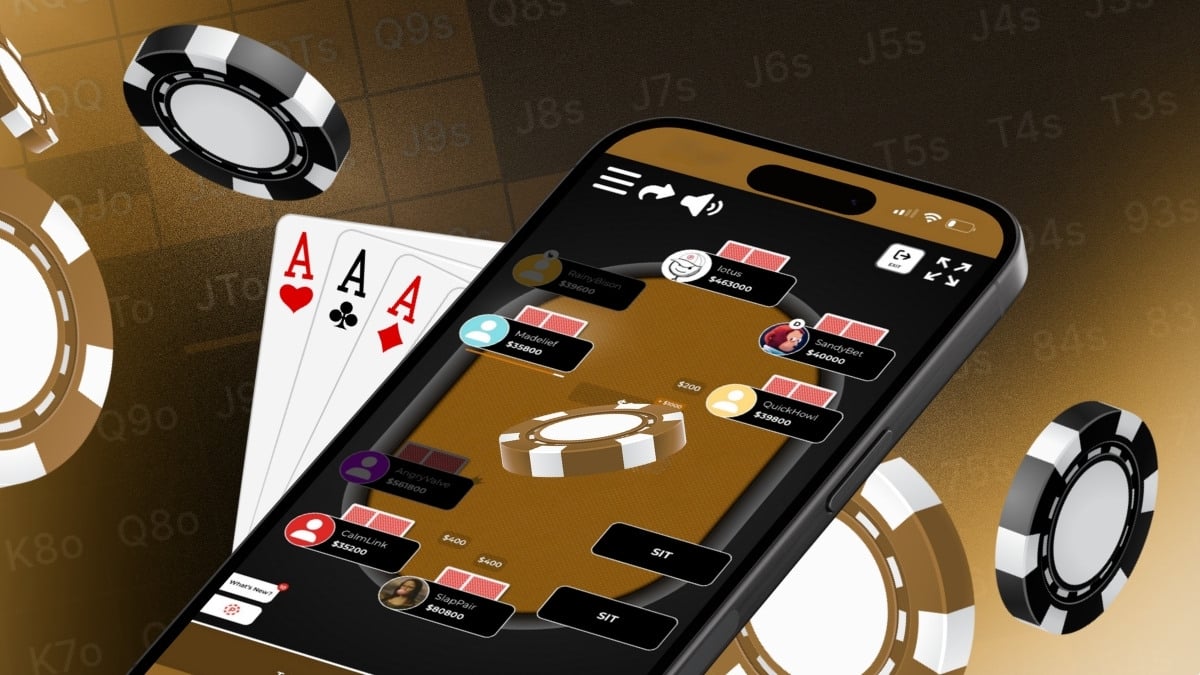

Game Theory Optimal, or GTO poker, is the closest thing the game has to perfect play. GTO builds a balance where a player’s actions form a system that can’t be taken advantage of, no matter what opponents do.
The idea isn’t new, but solvers and modern study tools have pushed it into the mainstream. Players can now test theories, analyze hands, and see in detail how balance changes across positions and board textures.
This guide breaks down the principles behind GTO, how and when to apply it, and what common traps to avoid.
What Game Theory Optimal Means in Poker
GTO is built on the concept of equilibrium: a point where no player can gain an edge by changing strategy alone. In poker, this translates into playing a perfectly balanced range of hands in every situation.
For instance, if you bluff too much, strong opponents can call more often and punish you. If you never bluff, they’ll fold every time you bet. GTO prevents either extreme by blending aggression and caution in mathematical harmony.
When applied correctly, GTO serves as a safety net in uncertain situations. While it doesn’t guarantee constant wins in the short term, it minimizes long-term leaks and exposes errors in less disciplined opponents.
GTO vs. Exploitative Play: When to Switch
A balanced GTO strategy works best against skilled or unpredictable fields. In those games, trying to guess what opponents will do can backfire, so a mathematically sound approach keeps you safe. Yet in softer environments where players repeat the same mistakes, exploitative play is more effective.
The key lies in switching cleanly between the two. Start from a GTO baseline and make selective adjustments based on data and observation. Track frequencies, note tendencies, and avoid overreacting to single hands. Over time, the balance between theory and adaptation becomes second nature.
For players looking to practice these shifts online, the best poker sites often include built-in resources to help bridge the gap between study sessions and live play, where decision speed and discipline matter most.
Building Balanced Preflop Ranges by Position
Every position at the poker table carries a different strategic expectation. Early seats demand tighter ranges since more players act behind you. Later seats, like the cutoff and button, allow for wider opens because there’s less chance of facing a premium hand. This shift is at the heart of GTO preflop balance.
Solvers show that early positions favor hands with strong equity and fewer speculative plays. Mid-position opens start to include suited connectors and lower pairs. By the time you reach the button, range expansion becomes aggressive, blending bluffs and medium-value holdings to pressure blinds.
Deviations from solver charts happen often in practice. When facing opponents who overfold or 3-bet too rarely, increasing open frequency becomes logical. In contrast, tightening up against aggressive tables preserves chips.
The structure of these preflop templates applies across any different poker formats, from online cash games to live tournaments. Position remains the foundation, but how players respond around you shapes where balance bends and where discipline pays off.
Flop Textures and Bet Sizing Patterns
Once the cards hit the flop, balance becomes a matter of sizing as much as range. Solvers categorize boards by texture and adjust bet sizes accordingly. Each texture changes who holds the range advantage, and that shapes how much to invest.
Here’s a simplified view of typical GTO patterns:
- Small bets (25–33% pot): Used on dry flops like A-7-2 rainbow where one player clearly holds more strong hands. These boards don’t shift much, so frequent small bets apply steady pressure.
- Medium bets (50–75% pot): Common on coordinated textures such as J-T-9 or Q-8-6 with suits. These boards hit both players and call for a balanced mix of bluffs and value.
- Overbets (125%+ pot): Reserved for polarized ranges—when your hand is either very strong or pure bluff. Overbets shine on low-card flops where you have nut advantage, such as paired boards or disconnected sets.
Understanding Minimum Defense Frequency (MDF)
Minimum Defense Frequency, or MDF, defines how often a player must defend against a bet to avoid being exploited. It’s a simple yet powerful tool derived directly from pot odds. The formula is:
MDF = Pot / (Pot + Bet)
Imagine an opponent bets 50 into a 100 pot. Plugging those numbers in gives 100 / (100 + 50) = 0.67, or 67%. That means you should continue (call or raise) roughly two-thirds of the time. If you fold more than that, your opponent could profitably bluff every hand.
MDF works best when ranges are balanced and your opponent’s bet size is consistent with GTO logic. Against players who never bluff or who overbet randomly, following MDF too rigidly can leak chips, but as a quick mental reference, it gives structure to defense decisions.
Turning Mixed Frequencies into Actionable Heuristics
Solvers often produce results like “bet 70% of the time, check 30%.” That precision looks impressive, but it isn’t realistic for live or online multitabling. The challenge is translating those outputs into guidelines you can actually follow.
A practical method is grouping actions into three tiers:
- Always: These are hands that perform strongly across all simulations, such as nut holdings on favorable boards. They form your core value range.
- Sometimes: Marginal hands or mixed-frequency bluffs that depend on board texture or opponent tendencies. These can shift based on table feel or past actions.
- Never: Combinations that lose value in nearly every model, often weak pairs or unconnected hands without equity.
The Role of Blockers in Bluff and Value Composition
Blockers decide which hands fit into your bluffing mix. A blocker is a card that reduces the chance your opponent holds certain combinations, shifting how many value hands remain in their range. Holding an ace on an ace-high board, for example, blocks strong top pairs, making that hand more suitable for bluffing.
Solvers balance these effects precisely. They assign higher bluff frequency to holdings that remove top pairs or draws from the opponent’s possibilities. Conversely, hands that unblock calls—like low pairs or weak kickers—rarely make good bluff candidates.
For players reviewing hands through analytics, many communities and tracker tools on a list of reliable poker sites now display blocker heat maps. These visuals highlight why certain bluffs work better than others and make complex solver data easier to digest for everyday use.
Simplifying Solver Trees and Using Node Locking
Solvers can feel overwhelming at first, but breaking their process into clear steps makes study efficient and repeatable. Here’s how to simplify solver use without losing depth:
- Trim unnecessary branches.
Remove extra bet sizes, redundant raises, and unrealistic actions. A simpler tree mirrors actual gameplay and produces faster, more readable results. - Define realistic assumptions.
Before running simulations, decide what average players actually do in your pool. This shapes the output toward practical use instead of pure theory. - Use node locking to model tendencies.
Lock specific opponent frequencies—like setting a 60% continuation bet or 30% river bluff rate—to see how your counterstrategy should change. - Study adjustments, not memorization.
Review how each lock alters solver outputs. The lesson isn’t the new percentage itself, but understanding why equilibrium shifts when opponents deviate. - Create repeatable study habits.
Run short sessions daily rather than massive once-a-week batches. Familiarity builds intuition, and smaller trees make it easier to absorb long-term patterns.
Free vs Paid Solvers: Which Ones to Start With?
Poker solvers vary widely in cost, features, and learning curve. Beginners can explore simplified versions without investing in complex paid platforms. Free options like GTO Wizard’s demo or PokerSnowie’s trial introduce basic equilibrium concepts and range visualization. They’re ideal for practicing simple heads-up spots and understanding frequency balance.
Paid tools expand the scope. PioSolver, Simple GTO Trainer, and GTO Wizard Pro allow multi-street analysis, customizable bet sizes, and node locking. These platforms show how small adjustments ripple across entire trees. The data is dense but deeply educational for players aiming to build advanced strategies.
For those who prefer digital currencies, many crypto poker rooms accept stablecoins and tokens for subscription payments. It’s a practical route for privacy-conscious players studying theory across regions.
Common GTO Learning Mistakes
Optimal play can go wrong fast if the study process lacks structure. Here are the main traps players fall into—and how to sidestep them:
- Memorizing charts instead of understanding logic.
Solvers reveal balance, not commands. Copying frequencies without context creates mechanical play that breaks down once real opponents behave unpredictably. - Ignoring exploitative opportunities.
A perfectly balanced line is safe but often leaves money on the table when opponents overfold or overbet. Use GTO as your baseline, then shift once consistent patterns appear. - Overvaluing small data samples.
Reading too much into limited hand histories can distort conclusions. Reliable adjustments need broad evidence collected over hundreds or thousands of hands, not a single night’s session. - Skipping post-study review.
Running solver simulations without testing them in practice turns theory into trivia. Reviewing real hands afterward helps merge math with lived experience. - Treating GTO as a fixed destination.
Balance isn’t a final state; it’s a moving point that shifts with every player pool and format. The best results come from flexible application, guided by reasoning rather than memorization.
Balancing Logic and Instinct with GTO Poker
Poker thrives on tension between reason and intuition. Game Theory Optimal play sits at the center of that balance, giving players a way to think through uncertainty, turning guesswork into a system of probabilities and measured risks.
But, because each table has its own rhythm, the real skill lies in blending the precision of solver logic with the awareness that every opponent is human. Numbers build the foundation, but instinct finishes the decision.
GTO may be mathematical at its core, but the art of poker still depends on how that math meets the moment and how calmly you trust the logic behind every move.





Published: Oct 13, 2025 09:20 am