


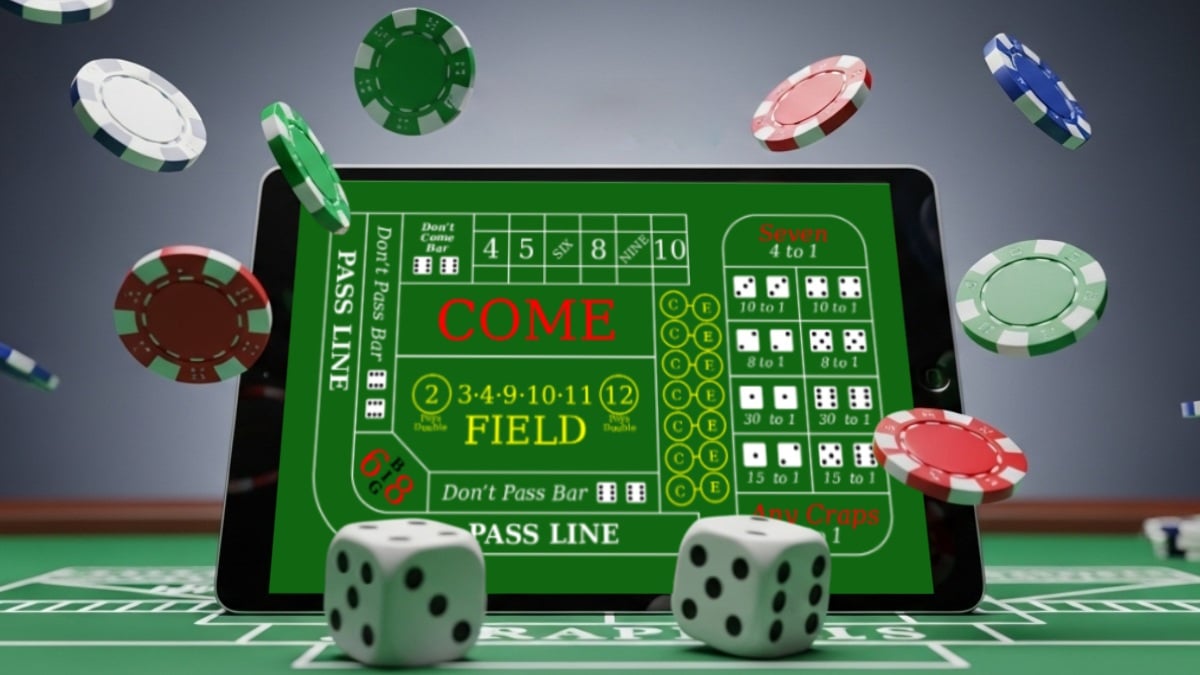

Understanding the difference between place and buy bets separates knowledgeable craps players from those leaving money on the table. Both bet types target the same point numbers, but distinct payout structures and commission charges create situations where one option delivers superior value. Mathematical analysis reveals specific scenarios where buying numbers reduces the effective house edge.
What Is a Place Bet in Craps?
Place bets enable direct wagering on 4, 5, 6, 8, 9, or 10 without requiring a come-out roll. The shooter must roll the placed number before seven for the bet to win.
Place Bet Payout Structure and House Edge
Casinos pay place bets at ratios below true odds to maintain a house advantage. A place bet on six pays 7:6, meaning a $6 wager wins $7 rather than the true odds payment of $6 for every $5 risked.
| Number | True Odds | Place Payout | House Edge | Minimum Bet |
| 4/10 | 2:1 | 9:5 | 6.67% | $5 |
| 5/9 | 3:2 | 7:5 | 4.00% | $5 |
| 6/8 | 6:5 | 7:6 | 1.52% | $6 |
Placing bets on six and eight offer the best house edge at 1.52%. According to Nevada Gaming Control Board data from 2024, place bets accounted for 18% of total table game wagers at Strip properties, with 6/8 combinations representing 65% of all place bet action.
Place betting requires proper unit sizing for correct payouts. Six and eight require $6 minimum bets to accommodate 7:6 ratios, while five and nine need $5 minimums for 7:5 payments.
What Is a Buy Bet in Craps?
Buy bets function identically to place bets regarding game mechanics, but pay true odds rather than reduced place payouts. Casinos charge 5% commission on buy bet amounts to maintain the house advantage.
Understanding Buy Bet Commission Structure
The standard 5% commission applies to buy bet amounts, though payment timing varies by property. Some charge a commission upfront when establishing the bet, while others collect only on winning wagers. This distinction has a significant impact on the effective house edge.
What does buy mean in craps? It signals the player wants true odds payout on point numbers rather than accepting reduced place bet ratios. The 5% commission represents the casino’s fee for providing fair payout odds.
Upfront commission charges mean players pay 5% regardless of outcome. A $20 buy bet on four requires $21 total risk ($20 bet plus $1 commission), with the $20 paying $40 on wins. Commission-on-win structures only charge when bets succeed, reducing the effective house edge. Many of the best online casinos now default to commission-on-win formats, giving players better mathematical value than traditional upfront structures.
Difference Between Place and Buy in Craps: Mathematical Comparison
The place or buy decision depends on whether the 5% commission creates better value than accepting reduced place bet payouts. Mathematical analysis reveals clear breakpoints.
When Buy Bets Offer Better Value
Buy bets on four and ten provide better value than place bets due to large payout disparities. Place bets on these numbers pay 9:5, while buy bets deliver true 2:1 odds minus 5% commission.
A $20 place bet on four pays $36 (9:5 ratio). A $20 buy bet pays $40 minus a $1 commission, for a net of $39. The $3 advantage favors buying over placing.
Buy bets on five and nine create marginal situations depending on the commission structure. With upfront commission, place bets offer better value. With commission-on-win, buy bets provide slight advantages on larger wagers. For example, a $25 place bet on five pays $35, while a $25 buy bet with commission-on-win pays $37.50 (3:2 true odds), minus a $1.25 commission, for a net of $36.25 – only slightly better than placing unless wager sizes increase further.
Six and eight should always be placed rather than bought. The 1.52% place bet house edge beats the 4.76% effective edge on buy bets. No commission structure makes buying six or eight mathematically superior.
Craps Buy vs Place vs Lay: Complete Strategy Analysis
Understanding when to place, buy, or lay numbers requires analyzing commission structures, bet sizing, and table-specific rules. The table below compares all three bet types across every point number to show how payouts and house edges shift depending on the wager.
Place vs Buy vs Lay Table
| Number | True Odds | Place HE | Buy HE (Upfront / Win) | Lay HE |
| 4 & 10 | 2:1 | 6.67% | 4.76% / ~1.67% | ~2.44% |
| 5 & 9 | 3:2 | 4.00% | 4.00% / varies | ~3.23% |
| 6 & 8 | 6:5 | 1.52% | 4.76% / ~4.0% | ~4.00% |
Lay Bet Example: $30 Lay on 4
A lay bet wins if a seven appears before the number you’re laying against. Because 7 has six combinations and 4 has only three, the probability of 7 arriving first is 66.67%. With a $30 lay bet on 4, you risk $30 to win $15 at true reverse odds (1:2). In a commission-on-win structure, the 5% fee applies only to wins, costing $1.50, for a $13.50 net profit on successful outcomes. If 4 appears first, the full $30 is lost, resulting in an effective house edge of roughly 2.44%.
Optimal Number Selection by Bet Type
- Always Buy: 4 and 10 at all bet sizes
- Usually Place: 6 and 8 at all bet sizes
- Situation-Dependent: 5 and 9 based on commission timing
Advanced players should verify commission policies before betting. Some properties charge $1 minimum commission regardless of bet size. A $10 buy bet paying $20 minus $1 commission nets $19, while a $10 place bet pays $18. Resources that offer detailed craps tips help players understand these nuanced betting decisions.
Commission Timing Impact on Strategy
Commission-on-win structures dramatically improve buy bet economics by eliminating commission charges on losing wagers. A standard 5% upfront commission means players pay regardless of the outcome, but a commission-on-win only extracts fees from successful bets.
A player making 10 buy bets on four at $20 each with upfront commission pays $10 total commission regardless of wins. With commission-on-win and three wins from ten attempts, the commission totals $3. The $7 savings reduce the effective house edge.
As of 2024, several Las Vegas properties, including Caesars Palace, Cromwell, Harrah’s, Park MGM, and the Venetian, offer commission-on-win buy bets on 4 and 10 at standard limits.
According to the UNLV Center for Gaming Research, published in 2024, commission-on-win structures reduce the effective house edge on buy bets by approximately 40-60%, depending on the number selection. This explains why informed players seek tables offering commission-on-win rules.
What Does It Mean to Buy a Number in Craps: Practical Application
Buying numbers requires specific verbal declarations and chip placement to distinguish from place bets. Proper communication prevents dealer confusion and ensures correct payouts.
Establishing Buy Bets at the Table
Players announce “buy the four for twenty” rather than simply placing chips, signaling commission payment and true odds expectations. Dealers mark buy bets with “buy” buttons, distinguishing them from place bets.
Commission payment timing requires attention at initial placement. Players should verify whether the property charges upfront or on a win, adjusting their chip placement accordingly. A $20 buy bet with upfront commission requires $21 ($20 bet plus $1 commission), while commission-on-win needs only $20 initially.
Many modern platforms offering mobile apps with live dealer craps clearly display buy bet commissions, eliminating confusion. Digital implementations often default to commission-on-win structures, providing better value than typical upfront charging.
Buy Bet in Craps: Advanced Strategy Considerations
Maximizing buy bet value requires understanding minimum commission thresholds, optimizing bet sizing, and adhering to property-specific rules.
Minimum Commission and Bet Sizing
Most casinos charge $1 minimum commission on buy bets regardless of the wager amount. This creates situations where small buy bets face disproportionately high effective commissions.
A $10 buy bet on four with $1 commission represents 10% effective commission rather than 5%. A $20 buy bet pays $1 in commission, which is 5% as intended. Players should buy in multiples of $20 to maintain proper commission ratios.
Some high-limit rooms and digital platforms with flexible betting software calculate commission to the penny, allowing $5 buy bets with $0.25 commission. These provide optimal value for smaller bankrolls.
Combining Place and Buy Bets in Single Sessions
Knowledgeable players employ mixed strategies using place bets on six and eight while buying four and ten. This optimizes expected value across all point numbers.
A typical spread includes $6 place bets on six and eight (1.52% house edge) combined with $20 buy bets on four and ten (4.76% effective edge with upfront commission, 1.67% with commission-on-win). This provides four-number coverage with a weighted house edge of approximately 2.5-3.0%.
Comparing Place and Buy Options Across Different Casinos
Casino rule variations create situations where place versus buy decisions shift based on property-specific commission policies.
Rule Variation Impact on Optimal Strategy
Some casinos charge a $1 commission per $25 wagered, rather than $20, effectively reducing the commission to 4%. This makes buy bets more attractive on marginal numbers, such as five and nine.
Others employ “commission on $25 or more” policies, charging no commission on buy bets under $25. These rules improve small buy bet economics and eliminate minimum bet sizing requirements.
Digital Platform Advantages
Online craps implementations often provide superior commission structures. Digital platforms can calculate precise commission amounts rather than rounding to whole dollars, thereby improving the economics of small buy bets. Platforms offering bitcoin dice games frequently extend similar advantages to craps variants.
Online environments clearly display all bet types, commission charges, and expected payouts before wagers finalize.
Place vs Buy Decision Matrix: Quick Reference
Always Place:
- Six and eight at all bet sizes
- Any number when the commission exceeds the payout advantage
Always Buy:
- Four and ten at $20+ with any commission structure
- Four and ten at $10+ with commission-on-win
Situational:
- Five and nine with commission-on-win at $20+
Players should verify table rules before establishing buy bets, as commission policies vary significantly. When uncertain, placing six and eight while buying four and ten provides a strong baseline strategy.
Making Informed Place and Buy Betting Decisions
The difference between place and buy in craps reduces to commission mathematics versus payout reductions. Buy bets on four and ten consistently deliver better value through true odds payouts that overcome 5% commission charges. Six and eight favor place betting due to a relatively low 1.52% house edge.
An optimal strategy requires verifying commission structure, understanding minimum charges, and sizing bets appropriately. Players who employ these principles reduce the overall house edge and improve their long-term expected value.
Please play responsibly. 21+, T&Cs apply.










Published: Nov 24, 2025 04:34 am